WESH, MeTV and Story Television in Ocala: Understanding the Channel 19 Broadcast Change
Technical explanation of WESH 2.1 NBC, MeTV 2.2 and Story Television 2.3 on RF Channel 19 in Ocala, including PSIP channel mapping, rescanning and antenna troubleshooting.
Viewers in the Ocala area may have noticed a recent change in the way WESH NBC, MeTV and Story Television appear on their televisions.
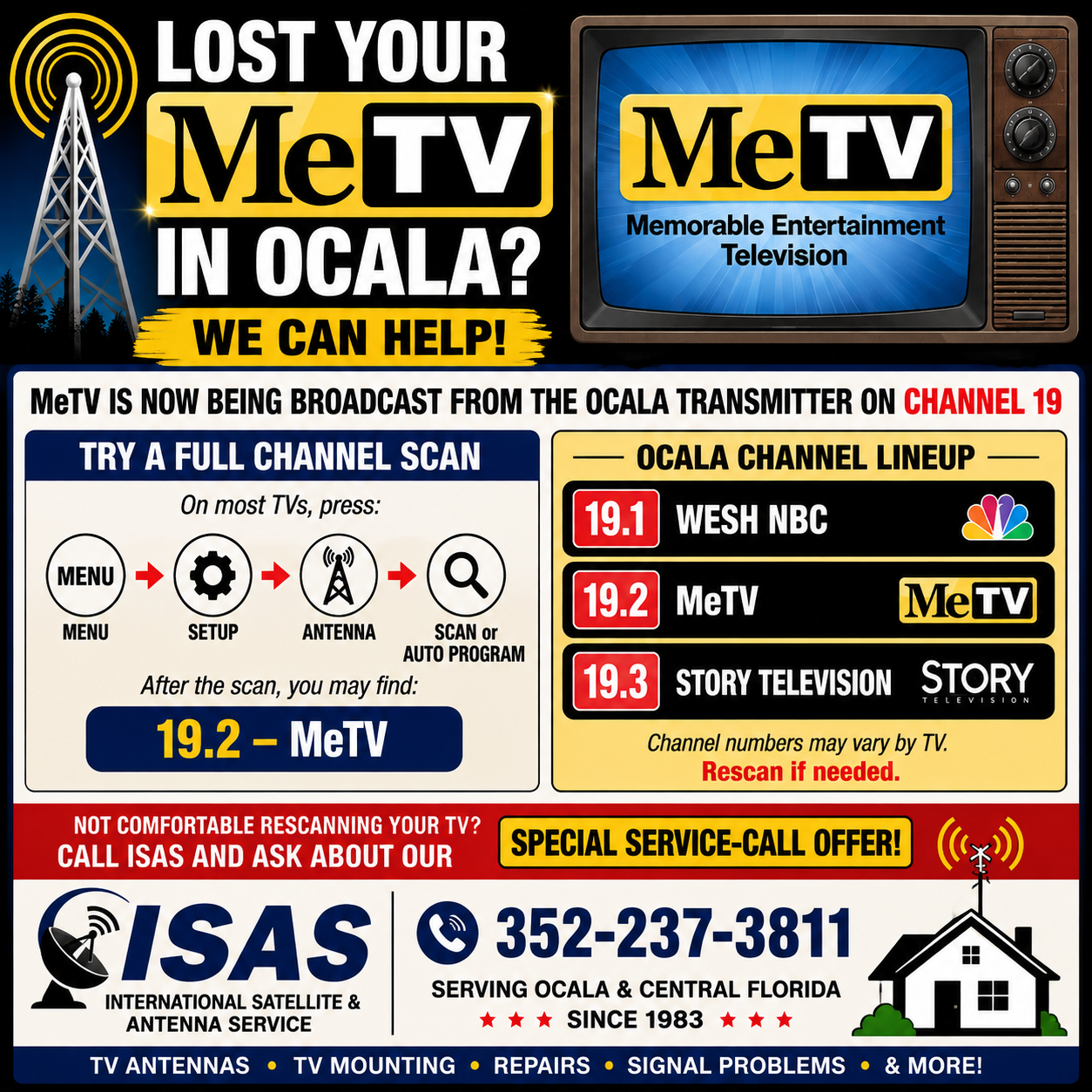
Some sets are now displaying the services as:
- 19.1 – WESH NBC
- 19.2 – MeTV
- 19.3 – Story Television
For viewers accustomed to finding WESH on 2.1, this can look like the station has changed frequencies. Technically, the situation is a little different.
WESH’s Ocala Signal Uses Physical RF Channel 19
The Ocala WESH facility is a digital replacement translator that operates on UHF RF Channel 19.
That means the actual over-the-air signal received by the antenna is transmitted on physical Channel 19.
Digital television, however, also uses a system called PSIP, or Program and System Information Protocol. PSIP allows a broadcaster to transmit on one physical RF channel while telling the television to display a different virtual channel number.
For example:
Physical RF Channel 19
may normally display as
Virtual Channel 2.1
This is why a television viewer may see “WESH 2” even though the antenna is physically receiving the signal on UHF Channel 19.
Why Are Some TVs Showing 19.1, 19.2 and 19.3?
If a television is now displaying WESH, MeTV and Story as 19.1, 19.2 and 19.3, the issue may involve the virtual channel mapping data being transmitted by the Ocala facility.
The actual programming may still be present, but the television may no longer be assigning the familiar virtual channel numbers.
This type of change can also cause older channel information stored inside the TV tuner to become outdated.
That is why a complete channel rescan is important.
What a Channel Scan Actually Does
When you run an antenna channel scan, the television tuner searches the available VHF and UHF spectrum for active digital television signals.
When the tuner finds RF Channel 19, it reads the digital transport stream and the associated channel-mapping information.
Depending on the current broadcast configuration and the television model, the set may then store:
19.1 – WESH NBC
19.2 – MeTV
19.3 – Story Television
or it may map them back to their traditional virtual channel numbers.
The exact display can vary by manufacturer and tuner software.
How to Rescan an Over-the-Air Television
Note: Rescanning may change or remove stored channels. Procedures vary by TV. If you are unsure, consult your TV manual or call us for help.
The menu wording varies from one television to another, but a typical path is:
MENU → SETTINGS → CHANNELS → ANTENNA/AIR → AUTO PROGRAM or CHANNEL SCAN
Before starting the scan, make sure the television input type is set to:
Antenna
Air
or
Over-the-AiR
Do not select Cable unless the television is actually connected to a cable television system.
Allow the scan to reach 100 percent before exiting the menu.
If the Channels Still Do Not Return
A missing channel is not always caused by the transmitter or the TV tuner.
If WESH, MeTV or Story are still unavailable after a complete scan, the antenna system itself should be checked.
Possible problems include:
- Insufficient UHF signal level
- Excessive coaxial cable loss
- Failed splitters or connectors
- Defective mast-mounted preamplifier
- Power-supply failure
- Lightning or surge damage
- Antenna misalignment
- Water intrusion in coaxial cable
- Multipath or local obstruction problems
Because the Ocala WESH translator operates on UHF Channel 19, the condition and UHF performance of the antenna system are especially important.
Signal Strength Is Only Part of the Picture
Digital television reception is not determined by signal strength alone.
A television can show a reasonably strong signal and still fail to decode the picture if the signal-to-noise ratio, multipath, or bit-error rate is poor.
Professional antenna troubleshooting may involve checking:
- RF signal level
- Signal quality
- Noise margin
- UHF response
- Amplifier gain
- Distribution loss
- Splitter loss
- Coax condition
- Grounding and bonding
- Interference from nearby electronics
This is why replacing an antenna is not always the correct first step.
ISAS Has Been Working With Over-the-Air Television Systems Since 1983
International Satellite & Antenna Service (ISAS) has been servicing television antenna systems throughout Ocala and Central Florida for more than 40 years.
If you have lost WESH NBC, MeTV, Story Television, or other local broadcast channels, we can determine whether the issue is simply a channel rescan or a problem somewhere in the antenna distribution system.
ISAS – International Satellite & Antenna Service
352-237-3811
Serving Ocala and Central Florida since 1983.